People of many different races, ethnicity, languages and cultures fill my daily life. When I look out my front window, I see children of all colors walking past on their way home from school. When I open my door to hand out candy on Halloween, I see faces of varying hues smiling up at me. In my own extended family, there are various races and ethnic backgrounds. My own genetic background is comprised of bloodlines from Great Britain, Switzerland, Italy, Spain, and some native blood. Spanish, Italian, and English are spoken by different members of my family. My husband's own background is German and Irish and he has a great-great grandmother that was full-blooded Cherokee. Everywhere I look in my life, from my mirror, to my family, to my neighbors, to my community, there is a diversity that enriches my life. (My hubby and I lament that we only know English and vow to one day learn Spanish)
I am aware that my own multi-ethnic appearance affects how people regard me. I have been taken for a variety of ethnic groups (Gypsy, Spanish, Italian, dark Irish, Indian, Pakistani, Israeli, Turkish, Mexican, Arabic, etc..etc..)and I have been racially profiled after 9-11 more times than I care to think about. Despite my funky colored hair, I am often pegged as being an Arab. I already know that I will always be pulled out of line at the airport. Sometimes I have hostile reactions to the fact I can't speak the language of the culture I have been mistaken to be a part of and have encountered downright angry looks for being with my "white" husband. One Indian woman in our old neighborhood made a point of shaking her head at me whenever she saw me with my husband.
So I have encountered (to some degree)prejudice and also the joys of living in a multi-cultural society.
How could I not translate that reality into my fictional worlds?
Yet, writing characters of varying ethnicity and race has opened my eyes to the reality of "white washing" in books and stereotypes that are very hard to shake. As I wrote in a previous post, my character of Jenni Blakely is half Mexican-American and half Irish-American. She speaks fluent Spanish and has no issue with her bi-ethnic background. It's just a part of who she is. Her appearance matches that of many Mexi-Irish people I have known with her dark hair and eyes, and pale skin. Yet, when people suggest actresses to play her role, they often suggest actresses that are not even a part Latina.
At first I wondered about this, then I slowly realized that a lot of people do not live in the multi-cultural melting pot that I do. Dark hair and eyes could translate into being "Latina" in their eyes.
Common recommendations for Jenni are:
 |
| Mira Kirshner |
 |
| Summer Glau |
My own personal pick is Oddette Annable, who is half Latina.

I do try to vividly describe my characters so that the reader can envision them close to how I see them on the movie screen in my head. The two leading picks for Jenni do have the dark hair and pale skin, but usually not her dark eyes and her Latina background. I've had a few readers send me emails asking why Jenni was speaking Spanish. They had obviously missed where she tells Katie her mother was Mexican-American.
Another strange stereotype of Jenni, is a few people who are shocked by the idea of her being so young and beautiful. Though her beauty is touched on several times in the books and her background is that of an abused trophy wife, a few fans had pictured her being older, fatter, and dumpy. One reader had added a narrative in their head that she had slowly grown beautiful over the course of the books.
But sometimes, no matter how hard I try to paint a vivid image of the character, a reader will default to the stereotype in their head. And its not the reader's fault. The media is very good at depicting certain ethnic groups in just one certain way and choose the same actors over and over again to fulfill that role.

Lou Diamond Philips became the face of Mexican-American males despite not sharing that heritage. I have had a few people tell me they imagined a young version of the actor for my character of Juan De La Torre.
 |
| Robert Rodriguez |
Yet, when I asked people who they would suggest for Juan De La Torre, an unusual number picked an actor who is nearly twenty years Juan's senior and not of Mexican-American descent, but actually Puerto Rican.
 |
| David Zayas |
David Zayas is a great actor. I have enjoyed him immensely on one of my favorite TV shows Dexter. Yet, he in no way resembles a construction worker in his late twenties with long tousled curls, green eyes, and a boyish grin. When I pointed this out to a fan, his response that in his mind Juan was a tired, middle-aged man looking for love and found it in (SPOILER) Jenni's arms.
I pointed out the description of Juan in the book, but David Zayas was the only Latino male actor the reader knew so he had altered the story in his head to fit around his visual of David Zayas as Juan.
Lenore doesn't get white-washed, but she does get crammed into the
 |
| Amber Riley |
From FIGHTING TO SURVIVE:
The two friends were complete opposites of each other: Lenore homely, chubby, a bit sloppy, and always grumpy while Ken was cute, fit, immaculately dressed and always in a good mood.
Lenore basically believes that everyone in the world is pretty much stupid. She's also a wallflower and doesn't say much, but when she does it is usually pretty funny and a delivered in a monotone. I describe her as Eeyore to Ken's Tigger, and that sums up Lenore perfectly. She is not an angry black woman. And she is not helplessly ghetto (whatever that means) and she is not sassy and sexy. One reader (and friend) told me she loved how Lenore was always "snapping her fingers and being sassy." Lenore would rather break off her own fingers than snap them.
 |
| Gabourey Sidibe |
Fans often suggest Amber Riley of Glee for the role. She's a lovely girl and a great actress, but she seems to have become the default "big black girl." I saw Lenore more along the lines of Gabourey Sidibe. A few fans even suggested girls with a more bombshell look, sexy and sassy. When I pointed out to a fan that Lenore was a big girl, the reader said that was never mentioned. I pointed out a few scenes where Lenore's size encumbered her when trying to escape zombies. Yet, Lenore was able to escape and was an asset to the fort. Her size didn't matter in the end.
 |
| Neville as Lenore |
Philip's final version of the cover perfectly captures Lenore.

"Ken is white?" a shocked fan emailed me.
With a sigh, I realized that because Lenore was black the assumption by a few was that her best friend was also black though he is described as looking Latino.
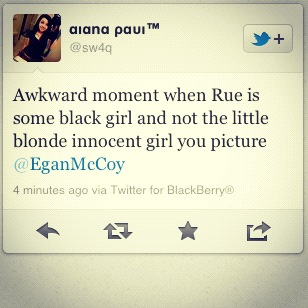
Sadly, I have realized that until there is more diversity in visual entertainment like TV and film, people will be stuck with the stereotypes that have been fed to them. This doesn't excuse the sometimes blatant racism of The Hunger Games fiasco, but it does cast some clarity as to why people sometimes overwrite the writer's depictions of their characters of color with their own translations.
This will not deter me from continuing to write diverse characters or attempting to portray them as something other than stereotypes.
So whenever someone asks me why I insist on clarifying the ethnicity/race of a character, my answer will be "Because the default is white and that is not realistic."
What are your thoughts, dear readers?